

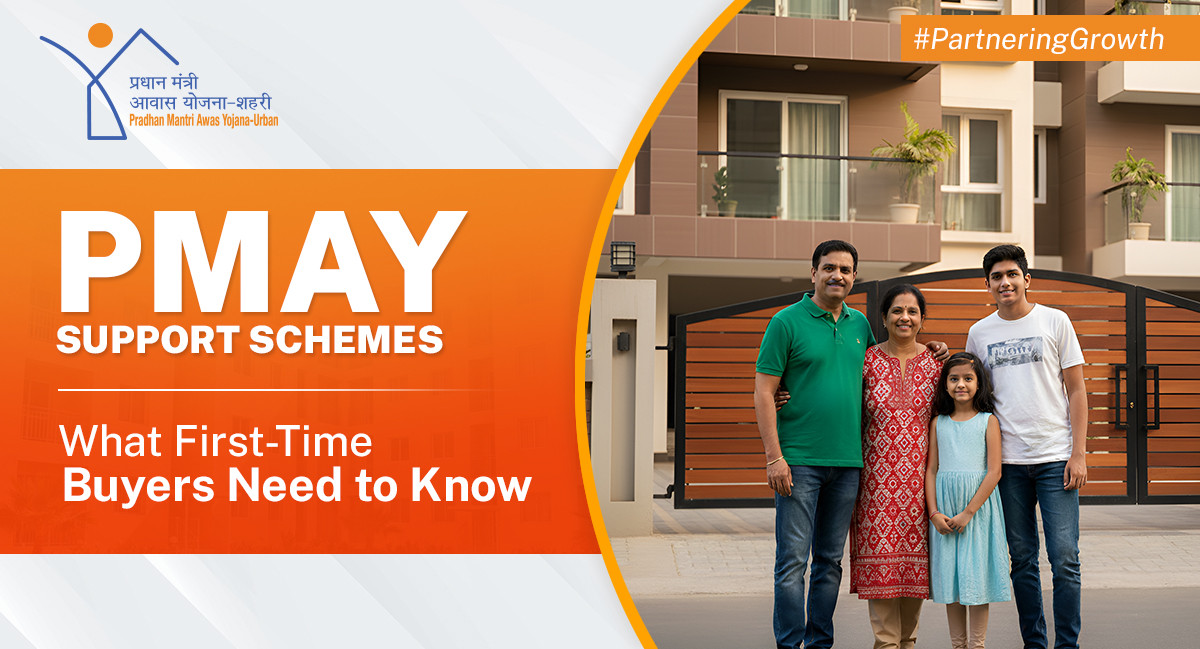
For many families in India, owning their own home remains a cherished dream. The Government of India’s flagship housing program, the Pradhan Mantri Awas Yojana (PMAY), continues to play a pivotal role in making this dream a reality, especially for first-time buyers across urban and rural India. With significant updates and expanded support frameworks in 2025, PMAY now offers enhanced opportunities and clarity for aspiring homeowners.
Overview of PMAY 2025-26
Also known as PMAY-Urban 2.0, the program was revamped in September 2024 and is slated to run until 2029. Under this mission, as per the PMAY dashboard, the government aims to build and subsidise over 1 crore affordable housing units for urban families falling under Economically Weaker Sections (EWS), Low-Income Groups (LIG), and Middle-Income Groups (MIG).
A total outlay of approximately ₹2.67 lakh crore (USD 30 billion), including committed funds for MIG extension, has been approved as central assistance under four key verticals:
1. Beneficiary Led Construction (BLC): Support for families to build homes on their own land.
2. Affordable Housing Partnerships (AHP): Subsidy for purchasing homes built by developers.
3. Affordable Rental Housing Complexes (ARHCs): Housing for migrant workers and urban poor.
4. Credit Linked Subsidy Scheme (CLSS): Interest subsidies on home loans for eligible buyers.
Eligibility and Benefits for First-Time Buyers
PMAY eligibility hinges on three main income categories:
1. EWS: Annual household income up to ₹3 lakh, eligible for up to 6.5% interest subsidy on loans up to ₹6 lakh.
2. LIG: Income between ₹3 to 6 lakh, same interest subsidy as EWS.
3. MIG: Divided into MIG-I (₹6-12 lakh) and MIG-II (₹12-18 lakh), with lower interest subsidies of 4.4% and 3.3% respectively, on higher loan amounts.
Subsidy benefits include a maximum subsidy of around ₹2.67 lakh for EWS/LIG families, while the upper subsidy for MIG segments has been recalibrated to ₹2.3 lakh (MIG-I) and ₹2.12 lakh (MIG-II) under the revised scheme, easing the financial burden of new home purchases and empowering families who previously found ownership unaffordable.
The application process for PMAY is facilitated through the unified online portal pmaymis.gov.in, where beneficiaries must register, submit Aadhar and income proofs, and select their applicable scheme category. Applications can be done directly or through PMAY partner lending institutions, including leading banks and NBFCs. Housing loans under PMAY-linked categories grew ~13% YoY in FY25, with NBFCs and HFCs disbursing ~₹1.1 lakh crore collectively under CLSS channels.
The government’s latest campaign, Angikaar 2025 (running from September to October 2025), aims to fast-track application processing through door-to-door verification drives, housing camps, and real-time grievance redressal, enhancing accessibility for first-time buyers.
Special Focus on Vulnerable Groups
Priority is given within PMAY to widows, single women, persons with disabilities, senior citizens, transgender individuals, and marginalised communities (Scheduled Castes/Tribes). Special provisions integrate with schemes like PM-SVANidhi for street vendors and PM-Vishwakarma for artisans to support their housing needs.
As of August 2025, PMAY-Urban 2.0 has been approved for over 8.5 lakh housing units, with significant representation from SC/ST and Other Backward Classes households. Central assistance covers multiple states and Union Territories, reflecting the scheme’s reach and scale.
For first-time buyers, PMAY offers a robust, transparent, and inclusive framework to transition from renting to owning a home with financial support tailored to income levels and social priorities. The renewed scheme and government campaigns in 2025 make this a promising time for aspiring homeowners to realise their dreams affordably and confidently.
 Uploaded On:
  Author: