

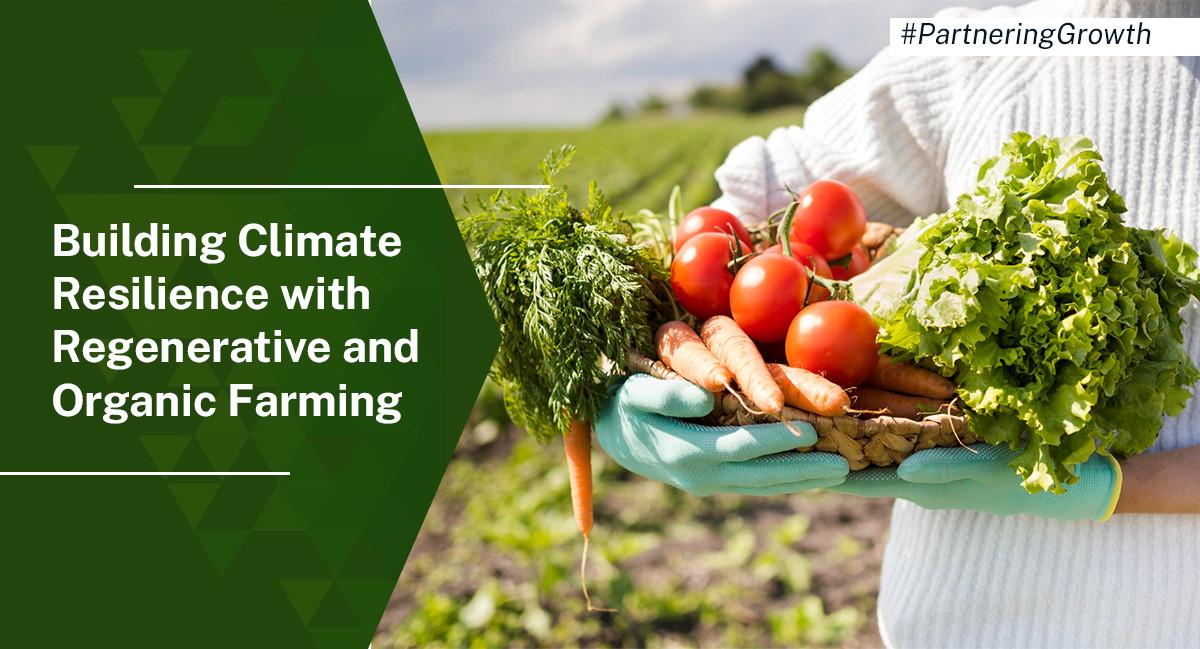
India’s agricultural sector stands at a critical crossroads as climate change intensifies, threatening food security, rural livelihoods, and natural resources. Regenerative and organic farming have emerged as transformative approaches that not only mitigate environmental harm but also build resilience against climate shocks. In 2025, these practices are gaining momentum across the country, driven by scientific innovation, policy backing, and growing farmer adoption.
The Promise of Regenerative Agriculture
Unlike conventional farming, which often depletes soil health and water resources, regenerative agriculture focuses on actively restoring ecosystems to a healthier state. Key practices include minimal soil disturbance (no-till farming), diverse crop rotations, cover cropping, agroforestry, integrated livestock, and organic inputs. These work together to build soil organic matter, enhance biodiversity, and improve water retention.
ICAR-NBSS&LUP data (2024) indicate that regenerative practices such as crop diversification, agroforestry, cover cropping, and sustainable soil management can lead to a 15–25% increase in soil organic carbon over 8–10 years, depending on regional conditions and crop systems. These practices enhance soil health, moisture retention, and nutrient cycling, aligning closely with the most recent scientific estimates. This leads to better drought tolerance, reduced flood damage risks, and higher yields in variable weather conditions- a vital climate resilience boost for India’s smallholder farmers.
Organic Farming: Complementary Path to Sustainability
Organic farming complements regenerative techniques by eliminating synthetic chemicals and focusing on natural soil fertility and pest management. The Government of India continues to advance organic and natural farming through evolving flagship schemes aimed at promoting sustainability and reducing chemical dependency.
The Paramparagat Krishi Vikas Yojana (PKVY) initially supported cluster-based organic farming through training, certification, and market linkages. From FY2023–24, it was integrated into the National Mission on Natural Farming (NMNF), launched in November 2024 to scale up chemical-free, climate-resilient agriculture based on local agro-ecological knowledge. The NMNF has a total outlay of ₹2,481 crore till FY25-26, including ₹1,500 crore allocated in the FY25-26 Budget for nationwide implementation.
Organic products are also commanding premium access in international markets, linking climate resilience with economic incentives for farmers engaged in sustainable practices.
Policy and Technology Enablers
India’s 2025 agricultural policies reflect rising emphasis on sustainable farming:
• The Prime Minister Dhan-Dhaanya Krishi Yojana, a national scheme under the Ministry of Agriculture & Farmers’ Welfare, was approved on July 16, 2025, and launched on October 11, 2025, by PM Narendra Modi; offers an annual outlay of ₹24,000 crore for six years (totalling ₹1.44 lakh crore), the scheme targets 100 low-performing districts, focusing on productivity, crop diversification, sustainable practices, irrigation, and credit facilitation. It consolidates 36 existing schemes across 11 ministries to transform backward districts into highly productive agricultural hubs.
• Besides this, the Mission for Aatmanirbharata in Pulses provides financial and technical support to improve productivity in climate-vulnerable regions.
• Carbon credit platforms such as Farmonaut, Boomitra (URVARA Project), GrowBillionTrees.com, and Rupiya.app enable farmers to monetise carbon sequestration from regenerative practices, turning sustainability into an income stream.
• Satellite-based tools, AI-driven monitoring, and blockchain-enabled traceability systems assist farmers in optimising resource use and validating environmental claims, fostering transparency and market trust.
Economic and Environmental Impact
The NITI Aayog GROW (Greening and Restoration of Wastelands with Agroforestry) report (2024) highlights that adopting regenerative agriculture through agroforestry, organic inputs, and natural farming techniques leads to significant reductions in external input requirements such as synthetic fertilisers and pesticides, resulting in cost savings of 25–30%.
Besides, these practices enhance soil health and moisture retention, leading to yield stability and improved quality, which translates to increased farm profitability in the range of 10–15% over a five-year horizon.
The regenerative and organic farming transition promises multifaceted benefits, including:
• Soil health improvements increase water use efficiency and nutrient availability, reducing the need for costly chemical fertilisers and irrigation.
• Enhanced biodiversity sustains pollinators and natural pest predators, lowering pesticide dependence.
• Climate-resilient farms stabilise yields and incomes, contributing to rural livelihoods and food security.
• Carbon sequestration in soils helps mitigate climate change while positioning India as a global leader in agricultural sustainability.
Challenges and the Road Ahead
Scaling regenerative and organic farming faces barriers, including knowledge gaps, initial yield variability, market access limitations, and fragmented support services. However, continued policy support, technology integration, and farmer-led innovations are paving the way for wider adoption.
As India moves forward, regenerative and organic agriculture will be central to building climate-resilient food systems that preserve ecological balance, empower farmers, and ensure sustainable growth.
Building climate resilience through regenerative and organic farming offers India a sustainable path to safeguard its agricultural backbone against climate risks. With concerted policy effort, technological enablement, and inclusive market strategies, India is poised to transform its farming landscape, nurturing both the soil and farmer livelihoods for generations to come.

 Uploaded On:
  Author: