

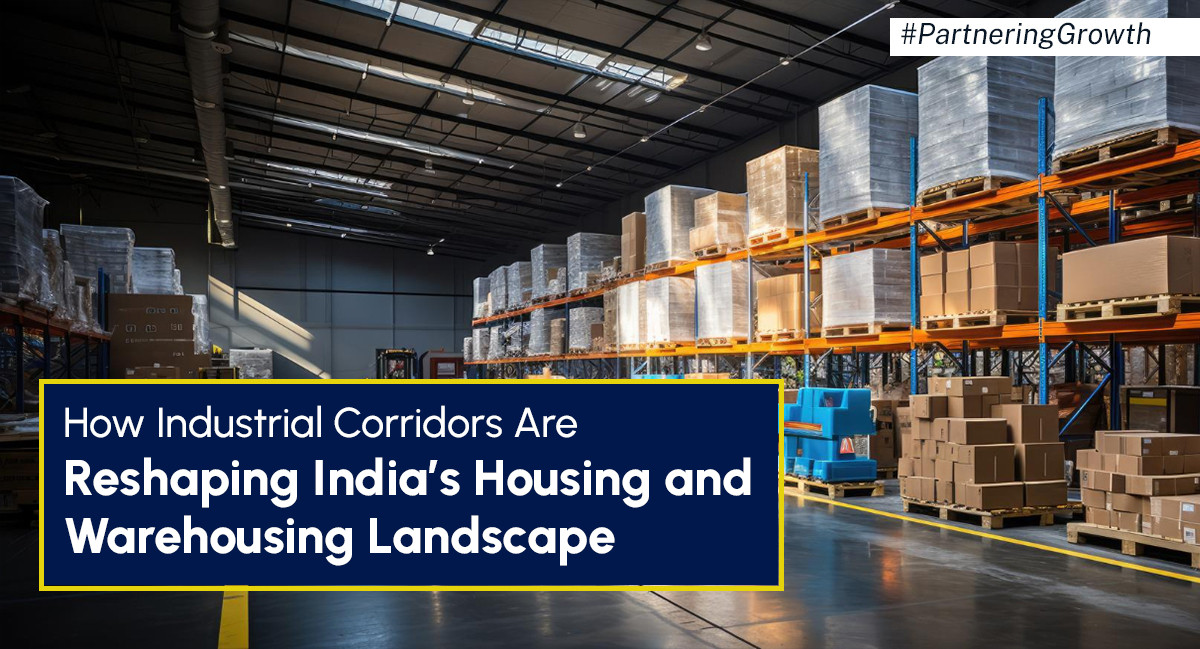
Industrial corridors in India are no longer viewed merely as manufacturing belts. From a policy lens, they are emerging as multi-nodal economic ecosystems, integrating production, logistics, labour mobility, and urban development. Programmes such as the National Industrial Corridor Development Programme and PM Gati Shakti have deliberately aligned transport infrastructure, land use planning, and industrial zoning. According to updates from the Ministry of Housing and Urban Affairs and the Ministry of Road Transport & Highways during 2025, corridor planning increasingly embeds residential and logistics zones alongside industrial nodes.
What stands out is that real estate development around these corridors is not sequential but simultaneous. Warehousing and housing are expanding together, driven by the same economic forces but serving different layers of demand.
Why warehousing becomes the first real estate response
From an infrastructure standpoint, industrial corridors significantly compress logistics timelines. Multi-modal connectivity—highways, dedicated freight corridors, ports, and industrial rail links—makes corridor locations ideal for large-format warehousing and distribution centres.
From a financial viewpoint, warehousing projects near industrial corridors benefit from:
• Predictable tenant demand from manufacturing, FMCG, and e-commerce supply chains
• Longer lease tenures and relatively stable rental yields
• Faster project stabilisation compared to commercial office assets
Policy-driven manufacturing incentives and supply chain localisation trends have also increased inventory holding closer to production centres. This has translated into sustained demand for Grade-A warehousing around corridors such as Delhi–Mumbai, Chennai–Bengaluru, and Bengaluru–Mumbai routes, as noted in 2025 infrastructure pipeline reviews.
Importantly, warehousing development sets the economic base with jobs, transport flows, and ancillary services, that trigger the next layer of real estate demand.
Housing demand follows as a structural necessity
Housing growth around industrial corridors is not speculative; it is workforce-led. Industrial nodes attract a wide spectrum of workers—shop-floor labour, logistics personnel, engineers, supervisors, and management professionals. Over time, this creates demand across housing categories:
• Rental housing and dormitory-style formats for migrant and contractual labour
• Affordable and mid-income housing for permanent employees
• Peripheral plotted and self-owned housing as corridors mature
From an urban development perspective, state governments have increasingly aligned housing approvals, trunk infrastructure, and municipal services around corridor influence zones. The result is the emergence of new micro-markets that are neither purely industrial nor traditionally urban.
In my view, the critical shift is that housing is now being planned as part of the industrial ecosystem, not as an afterthought. This reduces commute stress, improves labour retention, and enhances productivity—factors that feed back into industrial competitiveness.
Financial and compliance implications for real estate stakeholders
From a regulatory standpoint, corridor-led development brings both opportunity and complexity. Developers and investors must navigate:
• Zoning overlaps between industrial, logistics, and residential land parcels
• Phased infrastructure provisioning is impacting project cash flows
• RERA compliance across mixed-use developments
• Higher upfront capex for trunk infrastructure and internal connectivity
From a financial reporting angle, mixed-use corridor projects require careful segment-wise cost allocation, revenue recognition planning, and funding structuring. Construction cost inflation and interest rate sensitivity—highlighted in recent RBI and MoHUA commentary—also necessitate conservative feasibility assumptions, particularly for housing components with longer absorption cycles.
Warehousing, with its annuity-like cash flows, often plays a balance-sheet stabilising role, supporting the overall viability of integrated corridor projects.
Medium-term outlook: integrated urban–industrial clusters
Looking ahead, industrial corridors are likely to evolve into self-sustaining urban–industrial clusters rather than linear transit zones. Policy emphasis on planned urbanisation, logistics efficiency, and manufacturing competitiveness suggests that housing and warehousing will continue to grow in tandem.
A key implication is that real estate valuation around corridors will increasingly reflect ecosystem strength—connectivity, workforce availability, social infrastructure—rather than mere proximity to factories. From an economic standpoint, this integrated growth model supports employment generation, supply chain efficiency, and regional development, aligning closely with India’s medium-term growth objectives.

 Uploaded On:
  Author: