

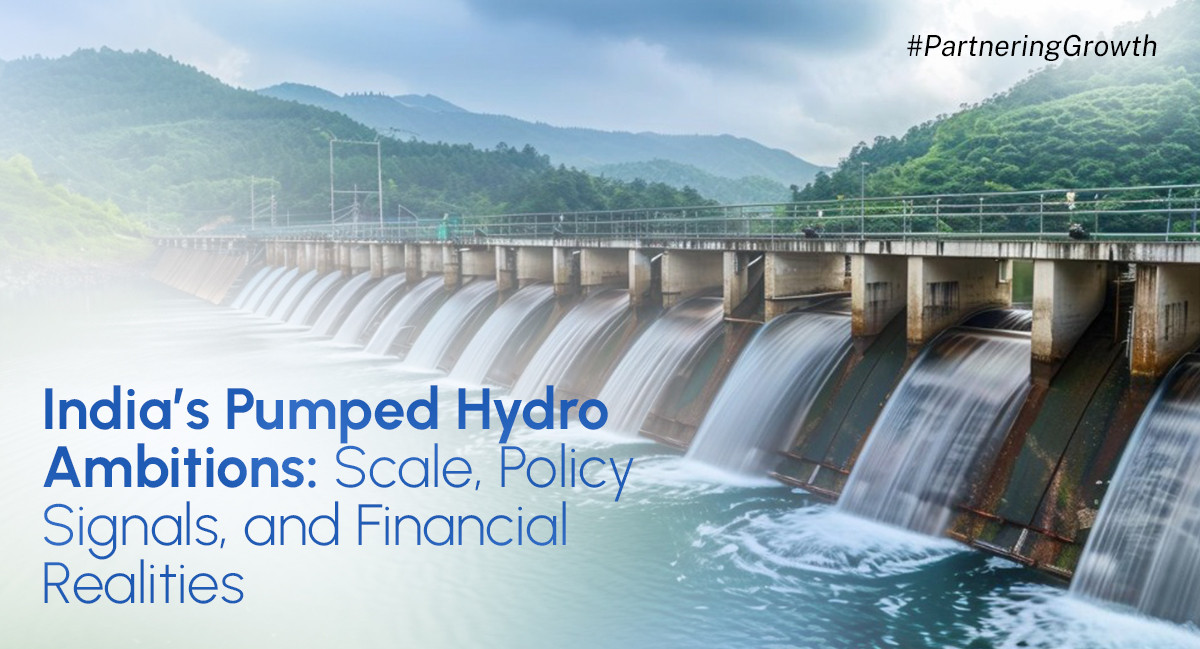
India’s power sector is entering a structurally different phase. Rapid renewable capacity addition, particularly solar and wind, has shifted the central grid challenge from generation adequacy to balancing and stability. From an energy economics standpoint, storage is no longer an auxiliary investment; it is becoming core infrastructure. In this backdrop, pumped hydro storage (PHS) has re-emerged as a strategic lever within India’s long-term energy planning.
The Storage Imperative Behind Renewable Expansion
According to the recent updates from the Ministry of Power and the Central Electricity Authority, renewable penetration has begun to exert visible pressure on grid operations, especially during off-peak demand hours and seasonal generation spikes. While battery energy storage systems (BESS) attract attention for their modularity, pumped hydro continues to stand out globally for long-duration storage, grid inertia, and cost efficiency over asset life.
What stands out is that storage requirements in India are increasingly being framed not just in megawatt terms, but in terms of dispatchability, reliability, and peak-shaving capability—areas where pumped hydro has historically performed well.
India’s Pumped Hydro Pipeline: Scale and Direction
From a policy lens, India’s pumped hydro pipeline has expanded significantly on paper over the last two years. As per Central Electricity Authority disclosures in 2025, multiple states, including Maharashtra, Andhra Pradesh, Odisha, and Rajasthan, have identified viable pumped storage sites, with several projects receiving in-principle approvals or moving into detailed project report stages.
While aggregate capacity estimates vary, the direction is clear: pumped hydro is being positioned as a backbone solution for renewable-heavy grids rather than a niche peaking asset. Importantly, recent policy clarifications have categorised pumped storage projects as renewable energy infrastructure, enabling access to concessional financing, priority transmission planning, and long-term offtake frameworks.
From a financial viewpoint, this classification materially alters project bankability, particularly for long-gestation assets with high upfront capital expenditure.
Global Comparisons: What Mature Markets Demonstrate
Globally, pumped hydro accounts for nearly 90% of installed grid-scale energy storage capacity, according to international energy agencies cited by Indian policymakers in 2025. Countries such as China, Japan, the United States, and several European economies continue to rely on pumped storage for frequency regulation and seasonal balancing.
China’s accelerated pumped hydro build-out over the last decade offers a relevant comparison. There, state-backed financing, assured grid integration, and long-term capacity payments have supported scale. European markets, on the other hand, demonstrate how merchant pricing mechanisms and ancillary service revenues can sustain pumped hydro assets even in liberalised power markets.
For India, the key lesson is structural rather than technological: storage viability improves when revenue visibility is policy-supported, and grid services are appropriately priced.
Financial, Accounting, and Regulatory Considerations
From a compliance and financial reporting standpoint, pumped hydro projects present distinct considerations:
• Capital intensity and depreciation: Long asset lives require careful alignment between depreciation policies and revenue realisation periods.
• Revenue certainty: Capacity payments, peak tariffs, and grid service contracts materially affect cash-flow stability.
• Water usage and environmental approvals: Regulatory timelines remain a key execution risk, with potential cost overruns if not factored early.
• State vs central procurement models: Differences in offtake structures affect risk allocation and financing terms.
What merits attention is that, unlike batteries, pumped hydro economics are highly sensitive to utilisation assumptions and tariff design, making regulatory clarity as critical as engineering feasibility.
Strategic Outlook for India’s Energy Mix
In my view, pumped hydro is unlikely to replace batteries; instead, it will coexist as the long-duration, grid-scale anchor in India’s storage ecosystem. As renewable capacity deepens and coal-based flexibility reduces over time, the role of pumped hydro as grid insurance becomes more pronounced.
From an industry risk perspective, execution discipline, environmental compliance, and financial structuring will determine whether India’s ambitious pipeline translates into operational assets. Globally, markets that have succeeded with pumped hydro did so by treating it as essential infrastructure rather than discretionary capacity.
India appears to be moving in that direction—gradually, but decisively. The coming years will reveal whether policy intent, financial frameworks, and grid planning align quickly enough to keep pace with renewable growth.

 Uploaded On:
  Author: